HOME of THE FLORIDA STATE PIKES


NATIONAL HISTORY
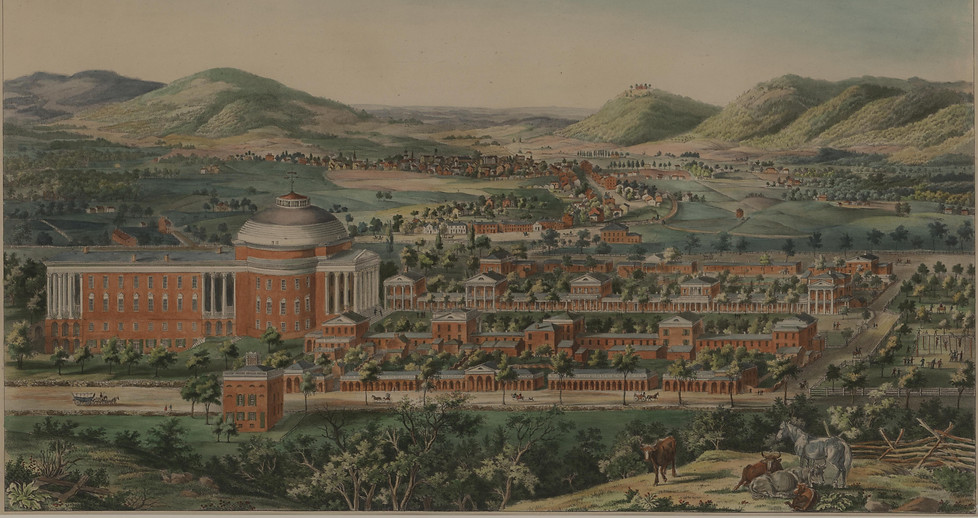
University of Virginia (circa 1870) — Aerial view of The Lawn, grassy area that separates the East Range and West Range student living quarters.


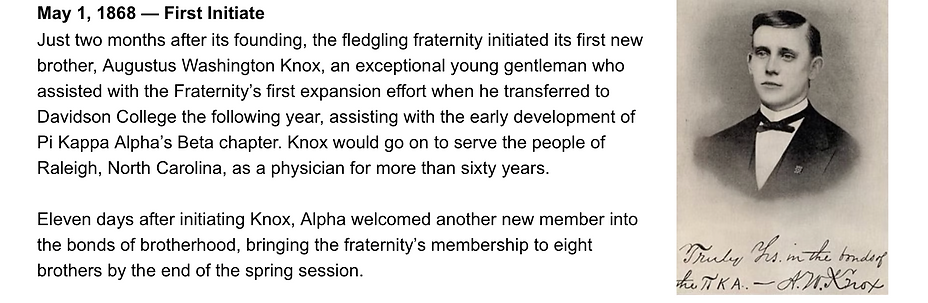

In an interesting twist, one of Alpha’s four new members in Fall 1869, was Franklin McNeil of Beta chapter, making an initiate of the Fraternity’s second chapter the Fraternity’s first transfer.
1870 -1872
The two years from 1870 to 1872 found Alpha established on the University campus as a mother chapter of a National Fraternity. During those two years a regular meeting place was obtained, the first convention was held, a formal chapter picture was made, and a program of expansion was outlined.

Alpha chapter’s first fraternity house: Castle Dango, Charlottesville, Virginia
A Secret Society
The term “Secret Society” in this period applied to more than just the initiation ritual and chapter procedure, but also the members and their meeting place. With the latter point in mind, the first Pikes began searching for a secret location as soon as the numbers of their membership made meeting in a student dorm room impractical from the standpoint of secrecy.
Various locations were considered, but none proved satisfactory until a brother thought of “The Castle.” “Castle Dango,” or “The Tin Castle,” as it was known by students of the time, was a large, red brick building at the top of a hill about a half mile from campus. Though not serving as a residence for the members, it was what would be viewed today as Pi Kappa Alpha’s first fraternity house.
1870s-1880s — Early Growth Period
Comprised of highly regarded men of character from prominent families, Alpha prospered during its early years. During its first 17 years, the chapter added many new members and attained a celebrated position within the University’s social circle. Additionally, Pi Kappa Alpha expanded to other college campuses, launching seven new chapters in its first decade. By the mid-1880s, a total of eleven charters had been issued across seven states, representing nearly 900 initiates.

Alpha Struggles With National Responsibilities
As the senior chapter, Alpha controlled the fraternity's reigns of governance, charged with overseeing the entire national organization. Its monarchal structure proved ineffective on a national scale, though. Proposals for changes in policy and operation had to be submitted to Alpha for consideration, and only Alpha could call conventions, limiting representation and efficiency.
While the fraternity’s original constitution called for annual conventions of the membership to openly discuss challenges and conduct pressing business, ever increasing internal struggles at Alpha resulted in its obligations to the national organization faltering. Over its initial 20 years, Alpha called for only three conventions, none of which had any legitimate impact on the fraternity’s long-term outlook:
• 1871 - Richmond, VA
• 1876 - Yellow Sulphur Springs, VA
• 1888 - Louisville, KY
As identified in the minutes of the respective gatherings, conventions at the time were essentially social occasions with very little business conducted.
Late-1880s — Contraction
By the mid-1880s, internal discord at Alpha began to erode active membership and limit recruitment efforts. Disorganization and poor communication weakened national leadership, causing waning interest among the expansion chapters. Over several years, many of the chapters failed. By Spring 1888, only four of the original eleven chapters remained active:
• Alpha (Virginia)
• Theta (Southwestern Presbyterian College; now Rhodes University)
• Iota (Hampden-Sydney College)
• Lambda (South Carolina Military Academy; now The Citadel)


A New Constitution
Since Alpha was barely functioning, the convention’s first priority was reorganizing its national governance. Representative delegates from three active chapters, plus a proxy acting on behalf of the fourth, created a committee to draft a new constitution that would vest supreme authority in a national board who were to be elected at the convention. As part of the new constitution, Rice presented a plan for creating a representative government in which each active chapter would elect one alumnus and one active member to create a Grand Council. Then, in turn, the Grand Council would elect two men to serve as the fraternity’s executive officers; the Councilor Priceps and the Grand Secretary and Treasurer. With the committee in agreement, the new constitution was presented to the membership and quickly adopted, clearing the path needed to rebuild the fraternity.
Election of National Officers
With the fraternity's new structure set, members elected its first Grand Council and executive officers; Rice as Grand Priceps, and Smythe as Grand Secretary and Treasurer (later divided into separate offices, with Foster taking on the Grand Secretary role.) The Officers and Grand Council assumed responsibility for the organization’s management and oversight. Their guidance and collective wisdom enabled the fraternity to establish long-term plans, rules of order, and take the actions necessary to address specific issues and achieve certain goals.
The Hampden-Sydney Convention marked the transition from a fragile organization struggling to survive to a sustainable, well-planned national fraternity with a vision for the future, set up for growth and prosperity. For his leadership in convening the convention that saved Pi Kappa Alpha, Theron Hall Rice is regarded as one of the most consequential figures in fraternity history.

No one was more affected by the University’s anti-fraternity regulations than Smythe, a local resident of Charleston who was a member of Lambda’s first class of initiates. So attached was he to the chapter he helped start that he secured permission from his father to set up a room in their family’s home exclusively for chapter use, which it remained for the duration of the chapter’s brief lifespan.
Business matters kept him from physically participating in the Hampden-Sydney Convention, but Smythe remained unfettered. He submitted a letter of apology for his absence, described by Foster as “glowing with fervent devotion,” in which he proclaimed his desire to remain active in the fraternity and asking Rice to serve as his proxy for the convention. In the years that followed, Smythe proved his love for the fraternity many times over by devoting himself to the national organization, creating a legacy of unmatched influence and service as a loyal alumnus, national officer, and

Cadet Robert A. Smythe
Lambda Chapter
The Citadel, Charleston, SC
esteemed ambassador for Pi Kappa Alpha to those outside the bonds of Pike brotherhood. Today, he is remembered at the fraternity’s annual convention during the presentation of its highest award for chapter excellence, which is named in his honor: The Robert Adger Smythe Award.

Perhaps more than any other, Smythe recognized that establishing and maintaining regular communication with the entire Fraternity membership was essential to its stability and future growth, and a magazine was the most efficient mass communication tool of the time. To illustrate his view of the magazine’s primary function, Smythe used that first edition to share the Minutes of the Hampden-Sydney Convention, including the revised Contstitution that was adopted at the convention.
In the Managing Editor’s note to readers, Smythe made a commitment to publish the magazine six times per year and reduce the cost per issue for subscribers from 25 cents to 15 cents. In exchange, he asked every member — undergraduates and alumni alike — to help defray the cost of publication and distribution by subscribing, ensuring that they will all be well-informed with timely, Fraternity-related news. To expand the network of chapter communication, he also requested that the alumni advisor from each chapter submit a brief update on news from their chapter each month to share with the rest of the Fraternity via Chapter Notes in the magazine..
“Without a magazine we cannot expect to accomplish anything.
And without support we cannot have a magazine. Not only do we want money,
but we want letters from our alumni to publish. Red hot, Fraternity letters.
Surely our alumni will do this.”
— Robert A. Smythe, Managing Editor
Pi Kappa Alpha Journal, Dec. 1890
1891 - Planning for the Future
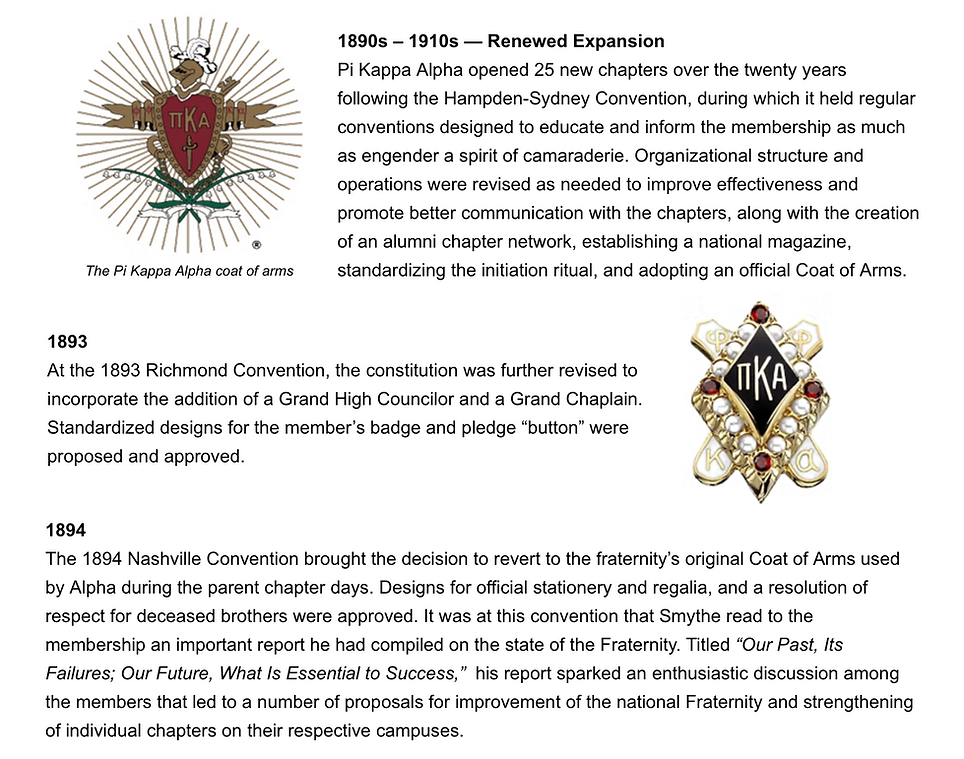
With the fraternity stableized, revisions to its governance were proposed at the Danville (Virginia) Convention in 1891, all designed to further strengthen the organization. The entire Grand Council was re-elected by their respective chapters. In turn, the Council elected the next Grand Priceps and Grand Secretary, while retaining Smythe as Grand Treasurer. Some constitutional revisions and a set of By-Laws to govern the Grand Council were proposed and adopted by the Coucil. An audit of the fraternity’s financial books was reviewed and approved. And looking toward symbolic representation for the growing fraternity, the membership adopted an official fraternity yell, flower, and flag.
The Modern Ritual
Authored by Smythe, the modern initiation ritual of Pi Kappa Alpha was approved for use in all chapters during the 1891 Danville Convention.
Reaching Maturity
In the five years since the Hampden-Sydney Convention, Pi Kappa Alpha had completely reorganized the national Fraternity structure, revitalizing existing chapters and expanding to include new chapters, all of which were managed by a sustained, stable board of chapter representatives and national officers. The practice of holding annual conventions was now established, focused on encouraging the exchange of ideas with the growing network of chapters and inspiring the shared pursuit of mutually beneficial natoinal goals. Pi Kappa Alpha was quickly transforming into a well-run, mature organization that could genuinely benefit its members, not just on their respective campuses, but also long after their college years. Pike brotherhood was becoming A Lifetime Experience.
With the Fraternity’s rapid growth, the corresponding increase in the size of the Grand Council of Delegates rendered national governance increasingly inefficient. To address the issue, significant reforms to the Fraternity’s leadership structure were adopted at the 1897 Nashville Convention, beginning with the abolition of the Grand Council and its authority transferred to the Grand Officers, who were thereafter elected directly by the membership at national conventions. Existing titles were also revised: the Grand High Councilor became the Supreme Councilor, and the executive board of officers was redesignated as the Supreme Council.

Attendees at the 1902 Nashville Convention were treated to a special keynote address by Littleton Waller Tazewell (Alpha), who spoke about his experiences as one of the Fraternity’s six founding members, and the pride he felt seeing the organization thrive and continuing to expand 34 years later.
1915 - 1945 — World Wars I & II
College enrollment declined during each of the global conflicts as young men joined the armed services by the hundreds of thousands, a challenging side effect of the wars that seriously impacted membership of all fraternities.
• World War I (1915-1919): One in six undergraduate Pikes saw military service.
• World War II (1941-1945): Nearly half of the Fraternity’s 33,000 undergraduate members served.
Strong post-war rebounds followed both conflicts, but wartime losses suffered among the brotherhood made an indelible mark on the Fraternity, leading to the decision to permanently honor those members who made the ultimate sacrifice in service to the nation.
1948 — PIKE Foundation
The PIKE Memorial Foundation was established, with the title later shortened to The PIKE Foundation.
1954 — Pi Kappa Alpha Memorial Headquarters
1988 —
The National Memorial Headquarters was dedicated in Memphis, Tennessee.
Pi Kappa Alpha Memorial Headquarters
8347 West Range Cove
Memphis, Tennessee 38125
(901) 748-1868
info@pikes.org